Stop Feeding Your Client the Cold Room Catalogue
How to read a client's business and let the racking choose itself
"We want racking like my friend's warehouse."
I've been hearing that for a thousand years. Clients want a storage system that matches their picking workflow, but they don't understand racking. That's when we step in as the mentor and lead the conversation forward — instead of talking about the refrigeration system they give zero fucks about. Most of them do. Yes.
The conversation usually goes like this. You do the small talk, but you already did the homework, so you know something about their business before the meeting. You interview them about their business nature in terms of high traffic or low traffic — the traffic of a frozen food distributor is totally different from a dry food distributor's. You ask how product comes in and out, packaging, pallets or loose items, and daily product load. You draft the outline of their business at a high level in your mind, to bring your client into your design journey. Now the details: the number of SKUs. Some hands-on owners give you the number instantly; some make a few phone calls to get it. Finally, SKU count, product packaging, and daily load decide which storage system you go with.
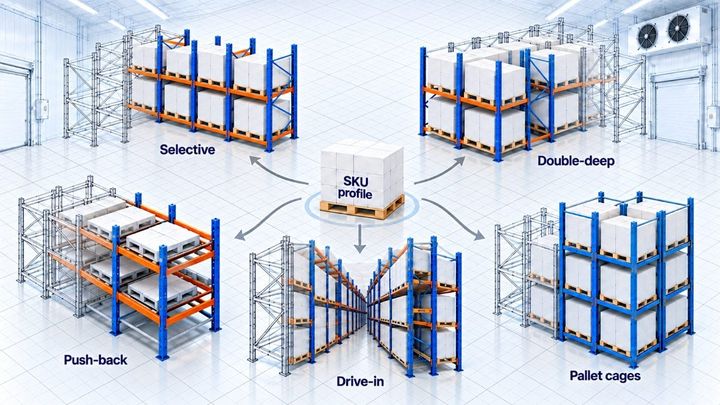
Four of those systems sit on one spectrum: single deep, double deep, push-back, drive-in. Cages answer a different question entirely. And the tree isn't a rulebook: customers split rooms between systems, double deep beside push-back, push-back beside cages, whatever their business logic demands. Here's the whole tree, one page, the way you'd sketch it on a notepad in front of a client.
Single deep (selective)
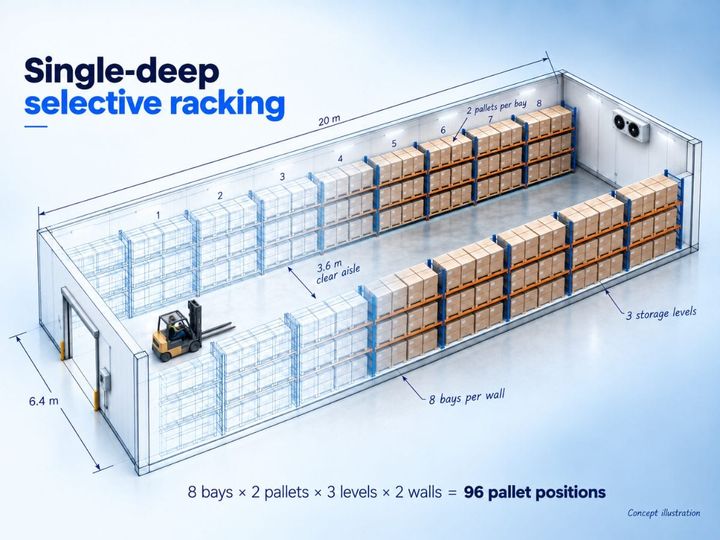
I would definitely go for selective when storage is below 100 pallets. It's the cheapest solution for a low daily load and low SKU count, and it stays flexible for loose items or pallet outbound.
Why below 100 pallets? Say we go for a 3-level, 2-sided wall racking. The aisle width is set at 3.6m to give the forklift a sufficient turning radius, so we set the room width at 6.4m. Now run 8 bays of 2-pallet selective racking along both walls, spanning the room length. You get 96 pallets: 8 bays x 3 levels x 2 pallets x 2 walls. The room's length of 8 bays costs 20m, which is still manageable and makes sense. That's the sweet spot, generally speaking. Past it, don't reach for a second aisle. That's almost never the priority.
You go deeper on the spectrum instead: double deep when the SKU count runs high, 500+ SKUs with capacity in the thousands, or push-back when it runs low, 20 to 50 SKUs holding more than a thousand pallets. Sometimes both, in the same room. And that's exactly where the tree starts. But it's a general rule and it bends: warehouse shape and traffic flow can override it, a long narrow room answers differently from a square one, and a dock that lands mid-wall changes the aisle logic before you draw a single bay.
Double deep
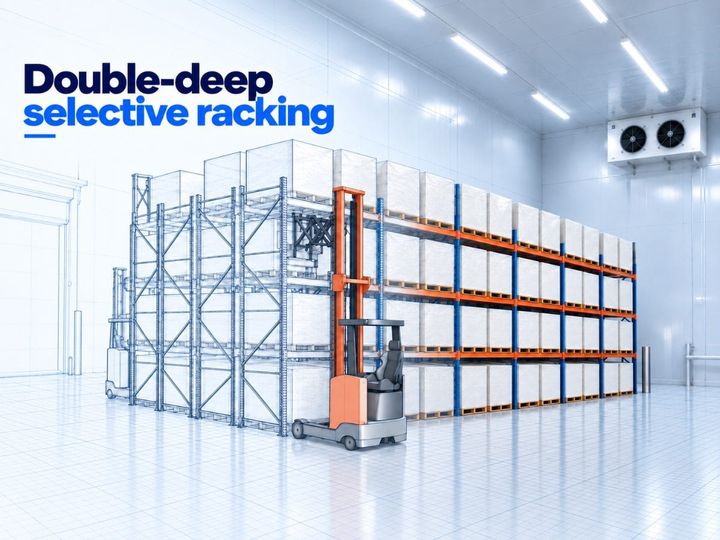
Two pallets deep; one reach truck serves both positions. And that truck is the first hidden cost in this conversation: it needs telescopic forks, it's a specialist machine, and it's a serious jump in price from the counterbalance that would run a selective layout.
In my experience double deep earns that truck when the SKU count runs above 500 and capacity climbs into the thousands of pallets — the cold chain logistics warehouse housing thousands of brands. Accessibility of each SKU is the main objective given high SKU counts and high pallet numbers.
The second hidden cost is the space. The logic is simple: you need 2 aisles to serve 8 rows of selective pallets. An aisle can serve up to 8 rows of push-back pallets, which is way more cost-effective for space utilisation.
Push-back
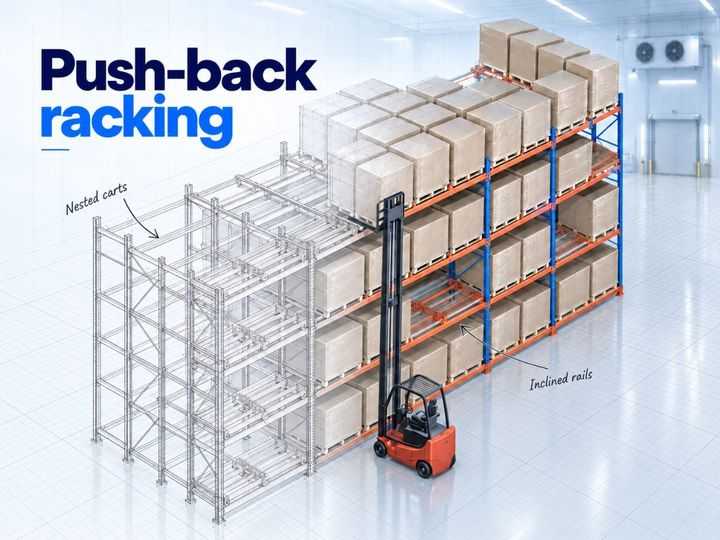
Pallets ride on carts down a lane, typically 2 to 5 deep, and each new pallet pushes the older ones back. The truck never enters the bay.
Push-back users don't speak in SKUs. They speak in containers, and the first question out of their mouth is the same every time: "How many of these fit in the room?" They count containers: one container, one SKU, and they'll tell you the room holds forty containers long before they tell you it holds forty products. Personal experience speaking, push-back comes into play when pallets go beyond 500 with SKUs not more than 50. Each lane houses one SKU.
The trade-off is aisle width in exchange for density. A deeper lane requires a longer truck, and a longer truck needs a wider aisle. Generally speaking, a pallet space of push-back costs 5 to 6x more than a selective one.
It's not a hidden cost — it's the price of the density, and the client pays it knowingly, because on the same footprint push-back holds more than double-deep selective ever could.
Drive-in
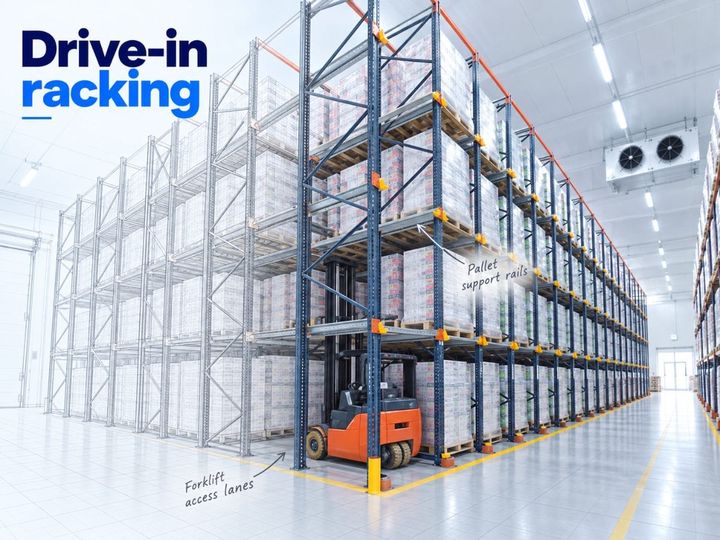
The cheapest option to go for higher density. The trade-off is the accessibility. The forklift drives into the rack itself.
On all levels, the first-facing layer of pallets must be cleared out for the reach truck to drive in and access the second-facing. You can imagine it's excruciating to practice first-in-first-out. Trade-off: time and labour.
Drive-in sits in quite an awkward position. Even with 2 pallets deep, some users pick push-back over drive-in. That's especially true for someone who has been through the drive-in picking workflow and rotation.
Pallet cages
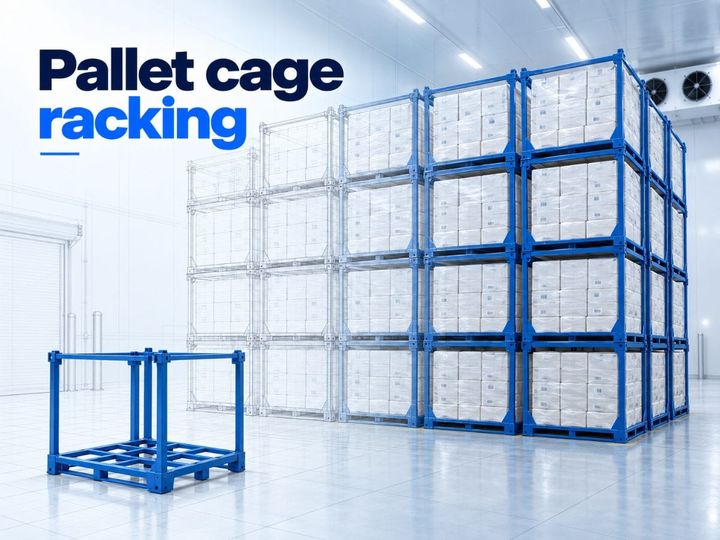
Pallet cages are stackable up to 4 layers high. The picking workflow is almost identical to drive-in. The difference is the outbound: drive-in stores pallets, and a pallet leaves the room for further handling. A cage is the outbound unit itself — it leaves whole, product and all, straight into the truck.
The favourite option for dry sundries distributors, poultry slaughter houses, and frozen seafood processors — low SKU, high volume.
For a dry sundries distributor, the pallet cage isn't just storage — it's the shipping unit. They load it in the cold room, pick it out, and wheel it straight into the 40-footer. No re-palletising on the dock, no second handling. The product goes into the cage once and stays in it until it's unloaded at the destination.
You see them everywhere. A cold room can be all cages: a single-SKU room where the same product fills every cage, stacked four high, picked whole, and shipped out of the same box. That's the cleanest cage case there is. But cages also slide in beside any of the other four — single deep, double deep, push-back, even drive-in — because they answer a different question than the pallet systems do. The racks decide how dense to store pallets; the cages decide where the loads that travel in their own unit live. Mix them however the business needs.
The tree on one page
Below 100 pallets, low SKU, mixed picks → single deep.
20 to 50 SKUs, more than a thousand pallets, the customer counts in containers → push-back. One container, one SKU, one lane.
500+ SKUs, capacity in the thousands, thousands of brands → double deep.
SKU count climbing past 50 in the container world → pallet cages beside push-back, for retrieval.
And the systems combine: double deep + push-back, push-back + cages. The customer's business logic splits the room, not a rulebook.
Second axis: throughput. Fast in and out favours selective; each step toward higher density trades speed for storage. Drive-in: the highest density on paper, awkward in a cold room. Rotation, one truck per lane, and the throughput story leave it rarely the right answer. Warehouse shape and traffic flow sit above all five branches. The tree is a starting point; the room gets the final say.
The four questions that place any client
How many SKUs do you hold at once?
How many pallets per SKU on a heavy day?
Does product need to leave in the order it arrived (FIFO)?
What shows up at your dock: pallets, totes, or loose items?
When you count your stock, do you think in SKUs or in containers?
A client who answers in containers, 20 to 50 of them, is a push-back prospect. A client with hundreds of SKUs and thousands of pallets is a double deep prospect. That first answer is the gap between the two systems. And a client who hesitates on these questions is a client you now know better than they know themselves. That's The Shift from issue one, applied to racking.
The cheat sheet
SINGLE DEEP
Gives: full selectivity, FIFO, fast mixed picking
Costs: floor and aisles
Truck: counterbalance or reach
Assumes: low SKU count, under 100 pallets, mixed picks
Walk away when: past the 100-pallet sweet spot, or SKUs climbing past what one aisle can serve
DOUBLE DEEP
Gives: roughly a third more pallets on the same footprint
Costs: back position only opens when the front is empty; sequence discipline; specialist reach truck
Truck: reach with telescopic forks
Assumes: 500+ SKUs, capacity in the thousands
Walk away when: the client can't hold sequence in their daily routine
PUSH-BACK
Gives: density near drive-in with per-lane selectivity
Costs: LIFO per lane, more moving parts, higher price per position; premium truck for deep lanes
Truck: reach truck, heavier and sized for the push
Assumes: 20 to 50 SKUs, 1000+ pallets, whole-pallet turnover, counts in containers
Walk away when: the client needs FIFO, or SKUs climb much past 50 without cages
DRIVE-IN
Gives: highest density on paper
Costs: LIFO only, one truck per lane; awkward fit in cold rooms
Truck: counterbalance or reach
Assumes: few SKUs, bulk quantities, long storage; rare in cold storage
Walk away when: the client needs throughput or rotation
PALLET CAGES
Gives: a home for loose items, totes, mixed picks
Costs: floor for what could have been stacked; rework if added late
Truck: hand pallet jack or counterbalance
Assumes: loose or mixed packaging, or SKU creep past 50 in a deep-lane room
Walk away when: everything arrives palletized
This was the map. Next issue we go deep on selective racking: single deep and double deep. When is a second aisle actually the right call, and when does the telescopic-fork reach truck earn its price? The 96-pallet sweet spot in this issue is just the starting point — the aisle math behind it gets a full issue of its own.
FAQ
- What is the best racking system for a low SKU count under 100 pallets?
- The best racking system for a low SKU count under 100 pallets is single deep racking. It offers full selectivity, FIFO, and fast mixed picking, making it a cost-effective solution.
- When should I consider using double deep racking?
- You should consider using double deep racking when you have 500+ SKUs and capacity in the thousands of pallets. It provides roughly a third more pallets on the same footprint but requires a specialist reach truck.
- What are the advantages of push-back racking?
- Push-back racking offers density near drive-in with per-lane selectivity, making it suitable for 20 to 50 SKUs with over 1000 pallets. It allows for whole-pallet turnover and counts in containers.
- What is the main disadvantage of drive-in racking?
- The main disadvantage of drive-in racking is that it only supports LIFO (Last In, First Out) inventory management, which can be awkward in cold storage environments and may not support high throughput needs.
- How do pallet cages differ from traditional racking systems?
- Pallet cages are stackable and designed for loose items or mixed picks, allowing for easy outbound handling. They serve as shipping units themselves, unlike traditional racking systems that primarily store pallets.